2026-03-26
Google's AI Co-Scientist Solved in 48h What Took Researchers 10 Years
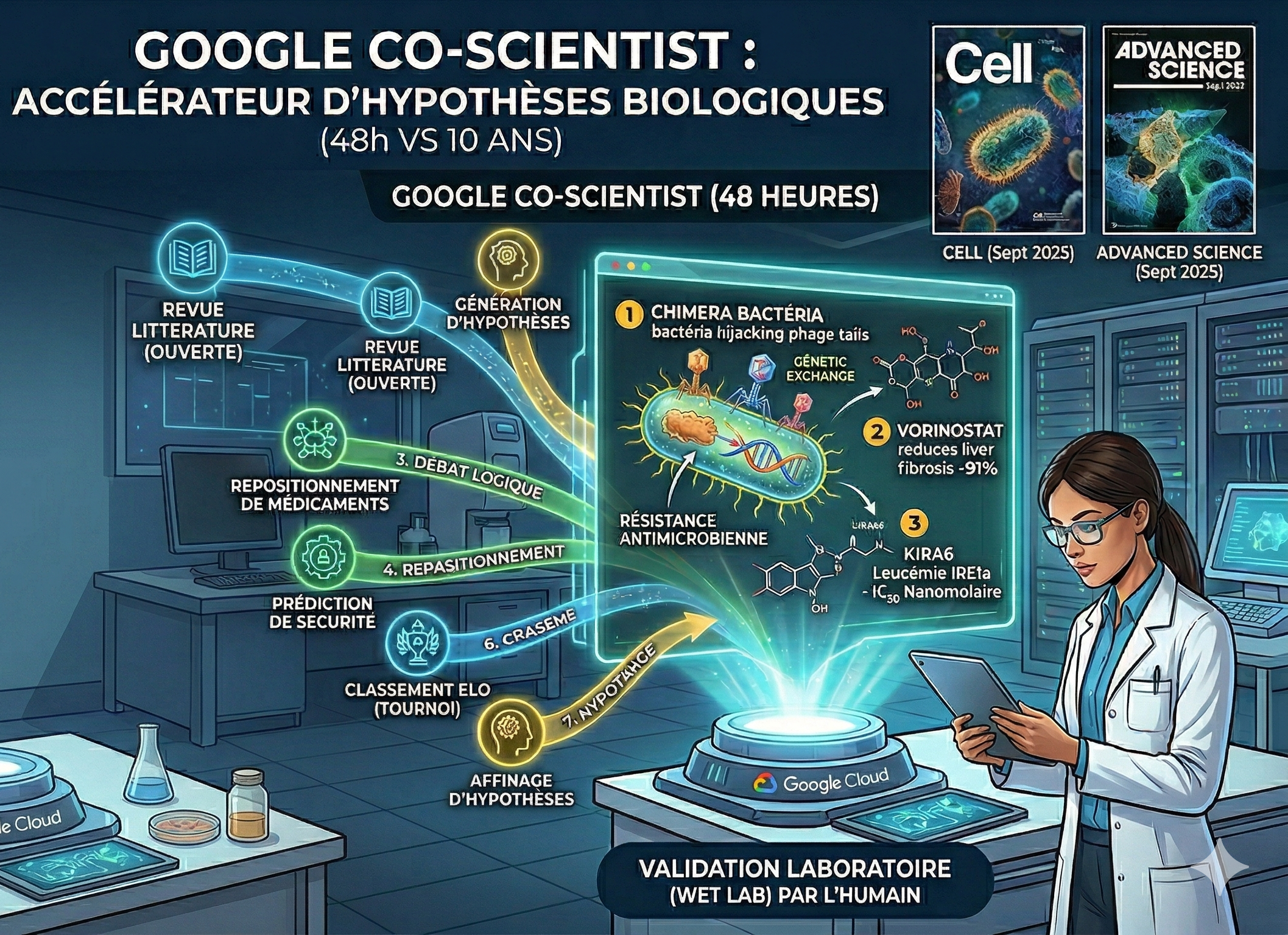
Google's AI Co-Scientist solved in 48 hours a biological problem that took a research team 10 years.
Not a benchmark. Not a demo. Lab-validated results published in Cell and Advanced Science.
Built on Gemini 2.0, this system uses 7 specialized AI agents that generate hypotheses, debate each other, rank them through Elo tournaments, then refine them. The human researcher stays in control.
Here are 3 results that stood out to me:
1. 10 years of work reproduced in 48 hours
Imperial College London, antimicrobial resistance. The AI proposed that bacteria spread their genetic elements by "hijacking" phage tails to form chimeric particles. This is exactly what the team had discovered through 10 years of unpublished experiments.
The lead researcher contacted Google thinking someone had accessed his computer. No other tested LLM found the right answer.
Published in Cell (Sept. 2025).
2. AI beats the human expert
Stanford, liver fibrosis. The AI proposed 3 classes of repurposed drugs. The expert (Prof. Gary Peltz) proposed his own candidates.
Result: 2 of 3 AI picks worked, including Vorinostat which reduced fibrosis markers by 91%. 0 of 2 expert picks worked.
Published in Advanced Science (Sept. 2025).
3. An invisible candidate against leukemia
Acute myeloid leukemia, Houston Methodist. The AI identified KIRA6, an IRE1a inhibitor never tested for this indication. Nanomolar IC50 across 3 cell lines.
A candidate no researcher would have found manually in the literature.
The reality check nobody is doing
AI Co-Scientist cannot access paywalled literature. It doesn't see unpublished negative results. It hallucinates. It has no access to your internal data. And above all: it runs zero experiments. Zero wet lab validation.
The numbers speak for themselves:
- 200+ drugs developed with AI assistance
- 0 FDA approvals to date
- 68% of AI failures in pharma come from data quality, not the model
The takeaway
AI Co-Scientist is a remarkable hypothesis accelerator. Not a shortcut to market.
To leverage it, you need:
- Structured internal data
- Custom workflows calibrated to your regulatory constraints
- A domain expert in the loop at every step
Generic AI moves fast. AI specialized for your pathology is a competitive advantage.
If you work in biotech and are trying to separate signal from noise on AI, book a 30-minute discovery call. It's free and with no commitment.